Table of Contents
- Why Personalised Direct Mail Cuts Through for Sales Outreach
- What You'll Need Before You Start
- Step 1: Segment Prospects by Value and Intent
- Step 2: Write Your Direct Mail Sales Letter Templates
- Step 3: Personalise Each Piece at Scale
- Personalised Direct Mail Examples That Get Responses
- Step 4: Set Up Direct Mail Response Tracking
- Direct Mail Campaign Best Practices for Sales Teams
- Frequently Asked Questions
Last Updated: 9 October 2026
Why Personalised Direct Mail Cuts Through for Sales Outreach
Personalised direct mail for sales outreach is the practice of sending physical letters that use a prospect's name, role, and buying history to start a sales conversation. A handwritten envelope is rare enough that people open it. Most inboxes are crowded. A letter on a desk is not. Physical presence alone is insufficient without a coherent direct mail strategy to ensure that the message resonates with the recipient long after the envelope is discarded.
That gap is the whole opportunity. Digital channels reward speed, so buyers now skim and delete. A physical piece forces a slower read, and a slower read is where trust starts.
Below, we show you exactly how to build a campaign: how to pick prospects, what to write, how to personalise at scale, and how to track what comes back. The five steps we cover follow the same order we would use on a live campaign.
Key Takeaway The letter is not the campaign. The list, the tracking, and the follow-up are. Get those right and the letter does the rest.What You'll Need Before You Start
You need three things before writing a single letter: a clean prospect list, the data fields you will personalise with, and a way to log responses. Skip any one and the campaign becomes guesswork.
Building Your Prospect List and Data Fields
Start with people you already have a reason to contact. Past enquiries, lapsed customers, and event sign-ups all beat a bought list.
For each contact, aim to hold:
- Full name and job title
- Company name and sector
- One specific detail from a past interaction
- The last date you spoke
- A clear next step you want them to take
That fourth field matters most. A letter that mentions a real conversation reads as human. A letter that mentions nothing reads as a mailshot.
Setting Up Tracking and CRM Integration
Decide how you will know a letter worked before you send it. The simplest method is a unique reply route for each batch.
Options that work well:
- A named contact and direct phone number on the letter
- A short web address printed on the page
- A QR code linking to a booking page
- A log entry in your CRM against each contact
RoboQuill integrates with CRM, API, Zapier, and Make, so each mailed contact can be tagged automatically. That tag is what turns a pile of letters into a report.
Step 1: Segment Prospects by Value and Intent
Segmentation decides your budget. High-value prospects get a longer letter and a faster follow-up. Low-value prospects get a short note or nothing at all.
Split your list into three groups:
| Segment | Who they are | Letter length | Follow-up |
|---|---|---|---|
| Hot | Booked a call or asked for a quote | Full page | Call within 3 days |
| Warm | Opened emails, no reply | Half page | Call within a week |
| Cold | No contact in 12 months | Short note | Email only |
A common mistake is treating every contact the same. It wastes effort on people who will never buy and under-serves the ones who will.
Step 2: Write Your Direct Mail Sales Letter Templates
A direct mail sales letter template is a reusable structure with fixed sections and blank fields for personal details. The structure stays the same; the details change per person.
Here is a template you can use today:
Dear [First name],
When we spoke on [date], you mentioned [specific problem]. I have been thinking about it since.
[One sentence on how you solve that problem.]
If it is still on your list, I can walk you through it in ten minutes. My direct line is [number].
Best wishes, [Your name]
Keep it under 150 words. Long letters get put down. Short letters get answered.
What most guides miss is the second line. Naming the exact problem the prospect raised does more work than any opening pitch.
Get prices for your campaign →
Step 3: Personalise Each Piece at Scale
Personalisation at scale means every letter carries details unique to that reader, even when you send hundreds at once. The trick is separating what changes from what stays fixed.
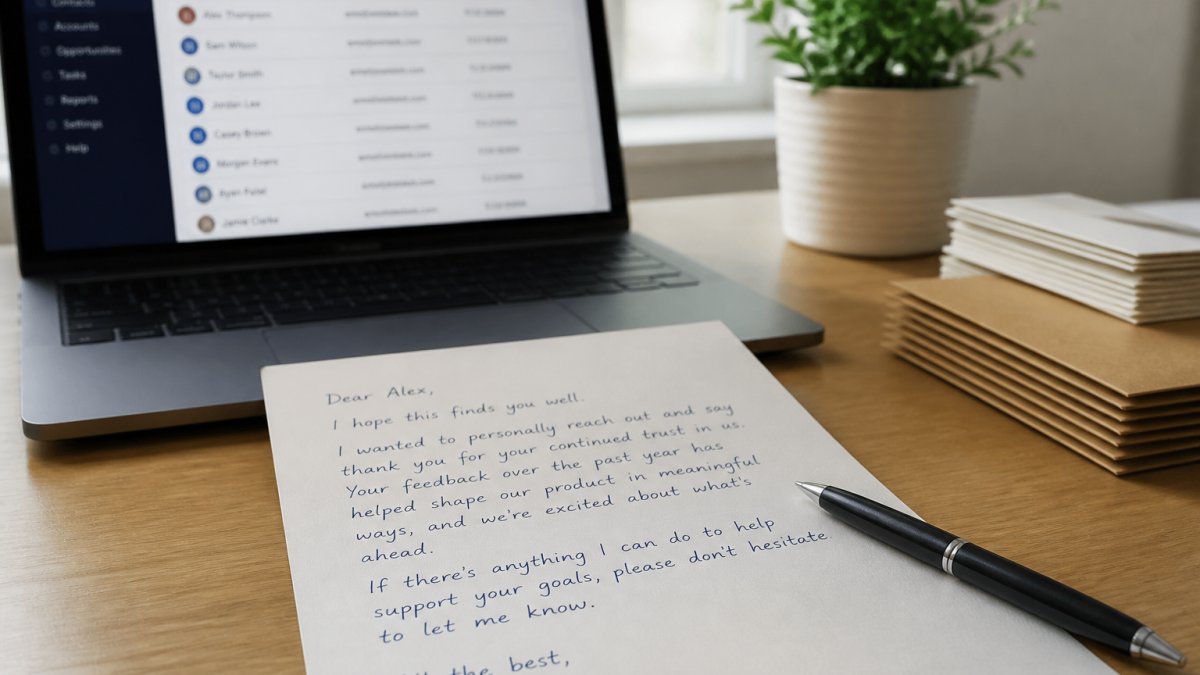
Fixed content: your offer, your signature, your contact details.
Variable content: name, company, the problem they raised, the date you spoke.
RoboQuill uses real pens and real ink. Robotic arms replicate natural human hand movement, so each piece features unique pen pressure, spacing, and flow. That variation is what stops a batch looking like a print run.
Pro Tip Test your variable fields on ten letters before you send a thousand. A misspelt company name in a handwritten letter is far more noticeable than one in an email.Personalised Direct Mail Examples That Get Responses
Strong personalised direct mail examples share one trait: they reference something only that person would know. Here are three formats that work.
The reminder letter. Sent to a prospect who requested a quote and went quiet. It repeats the quote date and asks one question.
The milestone letter. Sent to a customer reaching a renewal date. It names their account manager and offers a review call.
The referral letter. Sent after a customer recommends you. It thanks them by name and mentions who they referred.
Each one is short, specific, and asks for one action. That is the pattern.
Step 4: Set Up Direct Mail Response Tracking
Direct mail response tracking is how you connect a letter to a reply. Without it, you cannot tell a good campaign from a bad one.
Track four numbers per batch:
- Letters sent
- Replies received, by channel
- Meetings booked
- Deals closed
Match each reply back to the CRM tag from Step 2. If a batch of 200 letters produces no replies within two weeks, change the list before you change the letter.
Direct Mail Campaign Best Practices for Sales Teams
The best direct mail campaign practices come down to timing, follow-up, and honesty.
Send letters in batches you can follow up on. A letter with no call behind it is a leaflet.
Call within the window you promised. If the letter says three days, call on day three.
Keep your data lawful. Under UK GDPR and the Data Protection Act 2018, you must have a lawful basis for contacting someone and must honour opt-outs. The Information Commissioner's Office guidance on direct marketing sets out what that means in practice.
Check your claims. The Advertising Standards Authority codes require marketing to be honest and not misleading, which applies to letters as much as to adverts.
Watch Out Do not promise a specific response rate you cannot evidence. If results fall short, you have made a claim you cannot support, and that is a regulatory problem as well as a trust problem.Frequently Asked Questions
How do you personalise direct mail for sales outreach?
Start with the data you already hold: name, company, purchase history, and the specific trigger for contact, such as a test drive or a lapsed subscription. Use those fields to shape the opening line and the offer, not just the salutation. Handwritten pieces with real ink stand out because each one differs in pressure and spacing. Then match the message to the segment, so a high-value prospect gets a longer, more considered letter than a cold list contact.
How can you personalise direct mail at scale?
Scale comes from your data and your production method, not from cutting corners on the message. Build a spreadsheet or CRM export with consistent fields, then use merge logic to drop those fields into a template. Handwriting services that use real pens and robotic arms can produce thousands of unique pieces without the cost and lead time of a human handwriting team. Test a batch of 50 to 100 first to check data accuracy before you commit to a full run.
How do you measure the response to a direct mail campaign?
Give every piece a unique response route: a dedicated URL, a QR code, a campaign-specific phone number, or a reply code. Track those against your CRM so you can attribute meetings booked, replies received, and revenue influenced. Compare response rates by segment and by template variant. If you cannot tie a response back to a specific list and creative, you cannot tell which part of the campaign is working, so set up tracking before the first piece goes out.
How often should sales teams send direct mail to prospects?
For high-value B2B prospects, a sequence of two to three pieces over six to eight weeks works well: an initial letter, a follow-up with a different angle, and a final note if there has been no response. For e-commerce retention, tie mailings to lifecycle moments such as a renewal date or a lapse in activity rather than a fixed calendar. Sending too often turns a personal gesture into noise, so space pieces out and stop once you get a reply.
Cutting through a crowded inbox is hard, and most teams give up before the follow-up call. RoboQuill makes the physical side simple: real pens and ink, natural hand movement on every page, and CRM, API, Zapier, and Make integrations so each letter is logged automatically. If you want letters that land on desks and get replies, get prices for your campaign and see what a handwritten approach does for your pipeline.
Get prices for your campaign